Policy and Procedure No.3
Child Protection Policy, (written in conjunction with The Safer Programme, a part of Norfolk Safeguarding Children Partnership.)
“Millfield Pre-school is committed to safeguarding and promoting the welfare of children, young people and adults at all times and expects everybody working within the setting to share this commitment”
(Children’s Workforce Development Council 2009).
-
PURPOSE
1.1 The purpose of Millfield Pre-school’s safeguarding policy is to ensure every child at our organisation is safe and protected from harm. This means we will always work to:
- Protect our children and young people from maltreatment
- Prevent impairment of our children’s health or development
- Ensure that our children and young people grow up in circumstances consistent with the provision of safe and effective care
- Undertake that role to enable our children to have optimum life chances and enter adulthood successfully.
- Take action to enable all children have the best outcomes.
1.2 This policy will give clear direction to staff, volunteers, visitors and parents/carers about the expected behaviour and our legal responsibility to safeguard and promote the welfare of all children at our organisation.
-
INTRODUCTION
2.1 Our organisation fully recognises the contribution it can make to protect children from harm and supporting and promoting the welfare of all children. The elements of our policy are prevention, protection and support.
2.2 Our policy applies to all children, staff, volunteers and visitors.
-
OUR ETHOS
3.1 Our organisation will establish and maintain an ethos where our children feel secure, are encouraged to talk, are listened to and are safe. Children will be able to talk freely to any member of staff if they are worried or concerned about something.
3.2 All staff, volunteers and regular visitors will, either through training or induction, know how to recognise a disclosure from a child and will know how to manage this. We will not make promises to any child and we will not keep secrets. Every child will know what their chosen adult will have to do with whatever they have been told.
3.3 We will provide activities and opportunities that will endeavour to equip our children with the skills they need to stay safe.
3.4 At all times we will work in partnership and endeavour to establish effective working relationships with parents, carers and colleagues from other agencies.
-
PROCEDURES
4.1 When new staff, volunteers or regular visitors join our organisation they will be informed of the safeguarding arrangements in place. They will be given a copy of our organisation’s Safeguarding Policy and told who our Designated Safeguarding Lead/ Deputy Practitioner is. They will also be shown the recording format, given information on how to complete it and who to pass it to.
4.2 Every new member of staff or volunteer will have an induction period that will include essential safeguarding information. This programme will include basic safeguarding training through the Safer Programme relating to signs and symptoms of abuse, how to manage a disclosure from a child, how to record and issues of confidentiality. The induction will also remind staff and volunteers of their responsibility to safeguard all children and the remit of the role of the Safeguarding Lead/Deputy Practitioner.
4.3. All regular visitors and volunteers to our organisation will be told where our policy is kept, they will be given a set of safeguarding procedures, they will be told who our Designated Safeguarding Lead/Deputy Practitioner and alternate staff members are and what the recording and reporting system is.
4.4 All parent/carers will be asked to sign a contract confirming they have seen, read and understood our Safeguarding Policy. Parents and carers will be informed of our legal duty to assist our colleagues in other agencies with child protection enquiries and what happens should we have cause to make a referral to Children’s Services.
4.5 Parents will sign a consent form at the start of their child’s involvement with the organisation, which includes any vital health or otherwise notable information. It also requests permission for photographs to be taken for promotional purposes only.
4.6 In the event that a staff member has a concern about a child or family, they will complete a ‘record of concern’ form. This will be handed to the DSL or Deputy DSL. This will ensure the nature, time and date of the concern/disclosure is reported. DSL will acknowledge and act as needed. These will be stored in a separate folder, only accessible to the DSL.
5. TRAINING
5.1 Every member of staff will undertake appropriate safeguarding training in line with NSCP guidance and their role and keep this updated every two years maximum.
5.2 We actively encourage all of our staff to keep up to date with the most recent local and national safeguarding advice and guidance. This can be accessed on www.nscb.norfolk.gov.uk.
5.3 The Designated Safeguarding Lead/Deputy Practitioner should be used as a first point of contact for concerns and queries regarding any safeguarding concern in our organisation.
5.4 All staff have the opportunity to talk about policies and procedures during fortnightly staff meetings, termly supervisions and for regular updates to be shared by the Designated Safeguarding Lead/Deputy Practitioner.
5.5 Following a period of significant absence any practitioner shall undertake a return to work refresher induction regarding the Safeguarding and welfare policy and procedure.
6. SAFE STAFF
6.1 All adults who come into contact with our children have a duty of care to safeguard and promote their welfare. There is a legal duty placed upon us to ensure that all adults who work with or on behalf of our children are competent, confident and safe to do so.
6.2 Our aim is to provide a safe and supportive environment which secures the well-being and very best outcomes for our children. We do recognise that sometimes the behaviour of adults may lead to an allegation of abuse being made.
6.3 Allegations sometimes arise from a differing understanding of the same event, but when they occur they are distressing and difficult for all concerned. We also recognise that many allegations are genuine and there are some adults who deliberately seek to harm or abuse children.
6.4 We will take all possible steps to safeguard our children and to ensure that the adults in our organisation are safe to work with our children. We will always ensure that the Norfolk Safeguarding Children’s Partnership protocol Allegations Against Staff, Carers and Volunteers is adhered to.
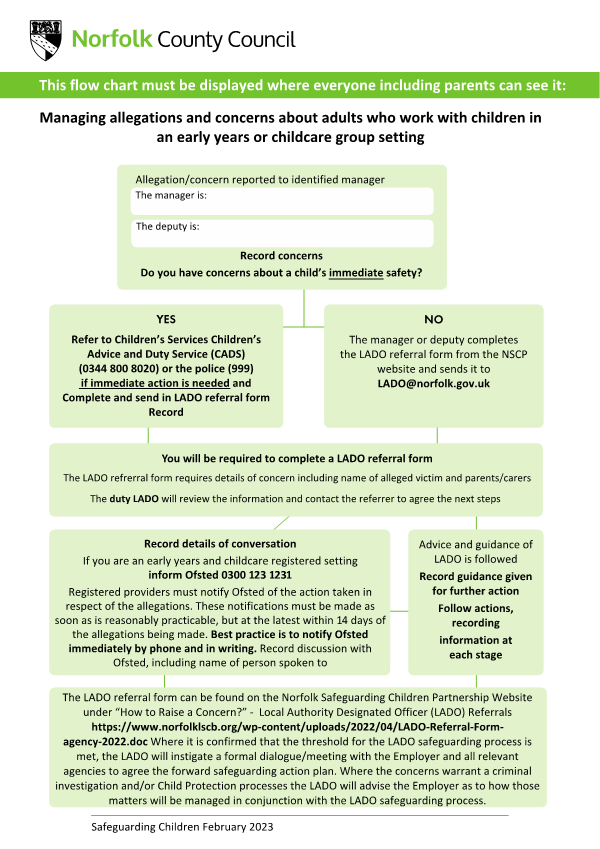
6.5 All adults who come into contact with children will be made aware of the steps that will be taken if an allegation is made. We will seek appropriate advice from the Local Authority Designated Officer (LADO). The LADO can be contacted on 01603 223473 and should be contacted within 24hours of the incident, especially if the allegation is against individuals who have direct contact with children.
6.6 Staff will not investigate these matters. We will seek and work with the advice that is provided. Should an allegation be made against the Designated Safeguarding Lead/Deputy Practitioner, this will be reported by the staff member or volunteer raising the concern who will liaise with the LADO. Staff members can also raise their concern with the chairperson of the committee.
6.7 There are sensible steps that every adult should take in their daily professional conduct with children. This can be found in the Safer Programme Safer Working Practice – this guidance is on the NSCP website and also in this pack.
7. RECORDS AND MONITORING
7.1 If we are concerned about the welfare or safety of any child all adults in our organisation will record their concern on the agreed report form (Form 2) and give this to the Designated Safeguarding Lead/Deputy Practitioner.
7.2 Any information detailed/recorded will be kept in a separate, confidential safeguarding file in a secure cabinet and not within the children’s general file. The Designated Safeguarding Lead/Deputy Practitioner will keep these files confidential. Any information within these files will only be shared with those that need to know in order to protect children in line with the referral process.
7.3 All safeguarding information/records will be kept in a secure individual, loose-leaf file and will be added to. Copies of referrals will be stored in the file. Files will only by accessible to those who need to know in order to protect children.
7.4 Reports of a concern to the Designated Safeguarding Lead/Deputy Practitioner must be made in writing and signed and dated by the person with the concern.
7.5 The Designated Safeguarding Lead/Deputy Practitioner will inform social care by letter if there are concerns about a child that leaves the setting.
7.6 All practitioners, committee members, volunteers or students will sign the Safeguarding Policy when amendments are made and therefore ensure the requirement of confidentiality.
-
ROLES AND RESPONSIBILITIES
8.1 Our Designated Safeguarding Lead/Deputy Practitioner will liaise with Children’s Services and other agencies where necessary, and make referrals to Children’s Services, seeking advice from the child’s Advice and Duty Service (CADS).
8.2 Any concern for a child’s safety or welfare will be recorded in writing and given to the Designated Safeguarding Lead/Deputy Practitioner who will be responsible for ensuring that all staff members and volunteers are aware of our policy and the procedure they need to follow.
8.3 The Designated Safeguarding Lead/Deputy Practitioner will ensure that all staff, volunteers and regular visitors have received appropriate child protection information during induction and if necessary have been trained by the Safer Programme.
8.4 The Designated Safeguarding Lead/Deputy Practitioner will ensure that our Safeguarding Policy is in place and is reviewed annually. The content of our policy has been written following consultation with the Safer Programme.
8.5 At all times the Designated Safeguarding Lead/Deputy Practitioner will ensure that safer recruitment practices are followed.
8.6 Safer procedures ensure our recruitment practices are safe and compliant with statutory requirements.
8.7 We require evidence of any qualifications staff or volunteers hold. We do not accept testimonials and insist on taking up references prior to interview. We will question the contents of application forms if we are unclear about them, we will undertake enhanced DBS checks and use any other means of ensuring we are recruiting and selecting the most suitable people to work with our children. We will use the recruitment and selection process to deter and reject unsuitable candidates.
8.8 Our organisation undertakes to remedy without delay any weakness in regard to our safeguarding arrangements that are brought to our attention.
-
PARENTS/CARERS
9.1 At MPS we are committed to promoting and ensuring that parents/carers understand and are aware of practices to ensure the protection and welfare of all children. These practices are shared through information such as:
- MPS registration pack
- Policy and procedures documents
- Newsletters
- Parent/carer notice board
- Ofsted parent/carers poster
- Duty of carer poster
- Allegations against staff process
- Accident and incident records
9.2 As parents/carers and practitioners we expect information regarding accidents or injuries that take place at home or within the setting to be shared by both parties.
9.3 If a practitioner has concerns regarding a child’s welfare, safety or behaviour then a Recording form for Safeguarding concerns (Form 2) and Body map will be completed. Information recorded on these forms will be shared between the Designated Safeguarding Lead/Deputy Practitioner and the child’s parent/carer, unless it is felt that the child is in immediate harm or danger and therefore a referral to CADS will be made.
-
WHAT IS ABUSE AND NEGLECT?
10.1 Abuse and neglect are forms of maltreatment of a child. Somebody may abuse or neglect a child by inflicting harm, or by failing to act to prevent harm. Children may be abused in a family or in an institutional or community setting, by those known to them or, more rarely, by a stranger for example, via the internet. They may be abused by an adult or adults, or another child or children.
Physical abuse
Physical abuse may involve hitting, shaking, throwing, poisoning, burning or
scalding, drowning, suffocating, or otherwise causing physical harm to a child. Physical harm may also be caused when a parent or carer fabricates the symptoms of, or deliberately induces, illness in a child.
Emotional abuse
Emotional abuse is the persistent emotional maltreatment of a child such as to cause severe and persistent adverse effects on the child’s emotional development. It may involve conveying to children that they are worthless or unloved, inadequate, or valued only insofar as they meet the needs of another person. It may include not giving the child opportunities to express their views, deliberately silencing them or ‘making fun’ of what they say or how they communicate. It may feature age or developmentally inappropriate expectations being imposed on children. These may include interactions that are beyond the child’s developmental capability, as well as overprotection and limitation of exploration and learning, or preventing the child participating in normal social interaction. It may involve seeing or hearing the ill-treatment of another. It may involve serious bullying (including cyber-bullying), causing children frequently to feel frightened or in danger, or the exploitation or corruption of children. Some level of emotional abuse is involved in all types of maltreatment of a child, though it may occur alone.
Sexual abuse
Sexual abuse involves forcing or enticing a child or young person to take part in sexual activities, not necessarily involving a high level of violence, whether or not the child is aware of what is happening. The activities may involve physical contact, including assault by penetration (for example, rape or oral sex) or non-penetrative acts such as masturbation, kissing, rubbing and touching outside of clothing. They may also include non-contact activities, such as involving children in looking at, or in the production of, sexual images, watching sexual activities, encouraging children to behave in sexually inappropriate ways, or grooming a child in preparation for abuse (including via the internet).
Sexual abuse is not solely perpetrated by adult males. Women can also commit acts of sexual abuse, as can other children.
Neglect
Neglect is the persistent failure to meet a child’s basic physical and/or psychological needs, likely to result in the serious impairment of the child’s health or development.
Neglect may occur during pregnancy as a result of maternal substance abuse. Once a child is born, neglect may involve a parent or carer failing to:
- provide adequate food, clothing and shelter (including exclusion from home or abandonment)
- protect a child from physical and emotional harm or danger
- ensure adequate supervision (including the use of inadequate care-givers) or
- ensure access to appropriate medical care or treatment.
It may also include neglect of, or unresponsiveness to, a child’s basic emotional needs.
Additional safeguarding concerns to be aware of are:
- Child Sexual Exploitation- Child Sexual Exploitation (CSE) is a type of sexual abuse where a child or young person is manipulated or coerced into sexual activity. This could be physical or through technology. Signs of CSE is a sudden change in behaviour, physical signs of abuse or changes in character. As with any concerns, all staff must listen to the child and report as soon as possible.
- Female Genital Mutilation (FGM)- FGM is when a female’s genitals are deliberately altered or removed for non-medical reasons. It’s also known as ‘female circumcision’ or ‘cutting’ but has many other names. FGM is a criminal offence in the UK and causes long lasting damage to physical and mental health.
- Forced Marriage- A forced marriage is where one or both people do not (or in cases of people with learning disabilities or reduced capacity, cannot) consent to the marriage as they are pressurised, or abuse is used, to force them to do so. Forced marriage is illegal in the UK. It is recognised as a form of domestic or child abuse and a serious abuse of human rights.
- Honour Based Abuse- Honour-based abuse is a crime or incident committed to protect or defend the ‘honour’ of a family or community. Honour-based abuse can include physical and emotional abuse, sexual abuse and forced marriage.
- County Lines- County lines is a type of criminal exploitation. Urban gangs persuade, coerce or force children and young people to store drugs and money and/or transport them to suburban areas, market towns and coastal towns. Once they have identified a child, the gang will make contact. This could be in person, via a mobile phone or online. Gangs may also use social media profiles to glamourise gang life and entice young people. Some children are groomed through family members, for example if they have a sibling or relative who is already involved with a county lines gang. If you think a child is in immediate danger, contact the police on 999.
- Child Criminal Exploitation- Child criminal exploitation is a form of child abuse where a child or young person is forced or coerced to engage in criminal activity or commit any type of crime.
- Radicalisation- Radicalisation is the process through which a person comes to support or be involved in extremist ideologies. See more in Policy No. 4- Prevent Duty and British Values.
- The Prevent Duty- Prevent safeguards people at risk of radicalisation. See pore in Policy No. 4- Prevent Duty and British Values.
- Online Abuse- Online abuse is any type of abuse that happens on the internet. It can happen across any device that’s connected to the web, like computers, tablets and mobile phones. Children can be at risk of online abuse from people they know or from strangers. It might be part of other abuse which is taking place offline, like bullying or grooming.
- Domestic Abuse- Domestic abuse is any type of controlling, coercive, threatening behaviour, violence or abuse between people who are, or who have been in a relationship, regardless of gender or sexuality. It can also happen between adults who are related to one another. Anyone, including a child, can witness domestic abuse and suffer significant impact. Children and young people can see/hear abuse, not receive proper care from their parents/carers because of abuse or be injured if caught up in domestic violence. Children can show changes in behaviour, language and presentation if witnessing domestic abuse.
-
OTHER RELEVANT POLICIES
11.1 To underpin the values and ethos of our organisation and our intent to ensure our children are appropriately safeguarded the following policies are also included under our safeguarding umbrella.
- Confidentiality – No. 1
- GDPR – No. 2
- Prevent, Duty and British Values – No. 4
- E-safety – No. 5
- Babysitting – No. 6
- Safeguarding Staff – No. 7
- Safer Recruitment – No. 8
- Whistle Blowing – No. 9
- Disciplinary and Grievance – No.11
- Observation, Assessment and Planning for Learning through Play – No. 12
- Keyperson – No. 13
- Health, Safety and Hygiene – No. 15
- Medicines – No. 20
- Sun Protection – No. 21
- Intimate Care – No. 22
- Emergency Evacuation – No. 23
- Lost or Uncollected child – No. 24
- Parent/Carer involvement – No. 25
- Admissions Pt. 1 – No. 26
- Transition – No. 29
- Special Educational Needs and Disabilities (SEND) – No. 33
- Behaviour Management – No. 35
- Comments and complaints – No. 42
-
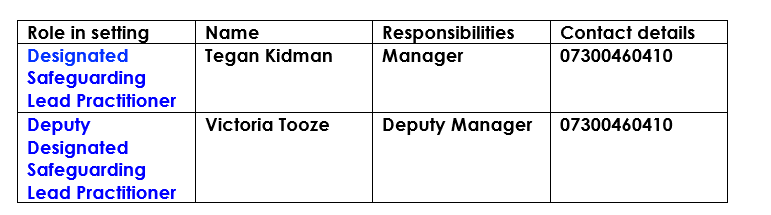
NAMED DESIGNATED SAFEGUARDING LEAD/DEPUTY PRACTITIONER.
For academic year 09/2025 -08/2026 the following designated staff are in post;
13. NORFOLK USEFUL CONTACTS
Children’s Services 24 hours: 0344 800 8020 (MASH)
Children’s Advice and Duty Service: 0344 800 8021 (CADS).
Norfolk Police: 0845 456 4567 In an emergency please call 999.
Local Authority Designated Officers (LADO) Team: 01603 223473 (Always someone available during normal working hours).
Norfolk Safeguarding Children Partnership (NSCP) – Policies & Procedures
Multi-Agency Safeguarding Hub (MASH) Team: 0344 800 8020
www.norfolk.gov.uk/mash
Ofsted 0300 123 1231
Guidance used in this policy and procedure:
‘What to do if you’re worried a child is being abused’ – Advice for practitioners – March 2015.
‘Keeping children safe in education’ – statutory guidance for schools and colleges – March 2015.
‘Information sharing’ – Advice for practitioners providing safeguarding services to children, young people, parents and carers – March 2015.
‘Working together to safeguard children’ – A guide to inter-agency working to safeguard and promote the welfare of children – March 2015.
‘Safeguarding in early years and childcare – Guidance for early years and childcare settings in Norfolk, publication from Norfolk County Council and Norfolk safeguarding children board (NSCB) – June 2012.
Referral Form or Initial Child Protection Conference Report Form
Signed: Clara Hall- Chairperson
Signed: Tegan Kidman- Lead Practitioner/Manager.
Reviewed: 28th January 2026
Review: 28th January 2027