Policy and Procedure No.19
Unwell Child/Accident and Injuries (including head injuries).
- To ensure the child’s needs are met when he/she becomes unwell at Pre-school, our policy is to send the child home. By doing this, the child will be in the best place, and it will protect other children and adults from risk of infection.
a. Any member of staff that suspects a child is unwell, contagious or sustains a head injury of any kind, must report this to the most senior member of staff.
b. The member of staff will ensure the child is as comfortable as possible and away from other children.
c. For unwell and contagious children, the person in charge will phone the emergency contact number, as listed on the child’s registration details in order for the child to be collected from the setting. If there is no answer, other listed emergency numbers will be contacted. In the case of a head injury, or other serious accident, the parent/carer or named emergency contact will be informed and if necessary, given the option to collect the child or for the child to remain in the setting.
d. If the parent/carer cannot be contacted the child will be cared for by the same member of staff until either the end of the session, or when the parent/carer arrives. In this case if staff ratios are not met then the Lead Practitioner/Manager or Senior Practitioner will call on another staff member.
e. If the child’s main carer cannot be contacted, please refer to Policy and Procedure No. 27 (Uncollected Child).
f. Parents will always be advised to contact a Medical Practitioner.
g. Where staff are concerned that a child may be seriously unwell, or if their condition deteriorates rapidly, e.g., suspected Meningitis, staff will call an ambulance as well as parents.
h. In the case of general accidents such as falls, trips, grazes and cuts a member of staff shall treat the child and monitor them. An accident report shall be completed if it is considered necessary. Parent/carers shall be informed of any accident/incident or injury on the collection of their child and asked to digitally sign the accident form. This will then be sent through our online communication system, Tapestry. In the case of head injuries, a head injury report in addition to the statutory accident report shall also have been completed and given to the parents/carers for their records and advice on the collection of the child.
- If a child needs to be transferred to hospital and parents aren’t yet at the setting, a staff member will accompany the child (ratios permitting) and stay with them until a parent/carer arrives.
- If your child has any of the following infectious illnesses or diseases, they will need to be excluded from Pre-school for at least 48 hours, or until clear (whichever is longer).
a. Chicken Pox- the child must stay home until all spots have crusted over.
b. Measles/German Measles
c. Sickness and Diarrhoea (please allow 48 hours from last incident).
d. Mumps
e. Conjunctivitis
f. Any other infections/contagious illnesses (e.g. children with repeated cases of Head Lice) judged by the senior staff member to warrant exclusion.
g. Impetigo-
Hand, Foot and Mouth is extremely contagious however keeping children away from other children doesn’t prevent the spread as this can happen before symptoms show. Children are asked to stay home if this is causing them to feel unwell and we recommend keeping the child at home if they have confirmed (by a medical professional) hand, foot and mouth however this is not something we can enforce, following NHS guidance.
The Manager/Deputy Manager will alert parent’s/carer’s if we have a confirmed case of a contagious illness to make them aware of signs and symptoms but also because they could be dangerous to certain individuals, eg. if an individual is pregnant.
- Epidemics/Pandemics
a. In the case of an epidemic or pandemic (as advised by Norfolk County Council), the Pre-school will continue to operate as normal while remaining alert to any child or member of staff exhibiting symptoms that could be symptomatic of the epidemic/pandemic. It may be necessary in some occasions that the Pre-school temporarily closes as a precaution to contain the spread of infection. In this case parents will be advised accordingly. This could be on health grounds if too few staff are available to guarantee child safety.
b. Further information concerning confirmed epidemics or pandemics is available from www.norfolk.nhs.uk which gives the latest information and links through the Department of Health, Health Protection Agency, World Health Organisation and Choices websites, where everyone can access more detailed advice and guidance.
Administering Calpol or Nurofen
It is not our policy to care for sick children, who should be at home until they are well enough to return to pre-school. However, we understand children will/can become unwell whilst in the setting.
- A child cannot attend the setting if they have been administered Calpol/Nurofen that day. The medication could be used to lower high temperature, as pain relief or if they are generally feeling unwell. Any use of this medication means they cannot come into preschool.
Children must not attend the setting if they have been given Calpol or Nurofen on the same day. These medications are commonly used to reduce a high temperature, relieve pain, or manage general illness; however, they can mask symptoms, particularly fever, which may place a child at risk. For example, a high temperature may go unnoticed, increasing the likelihood of febrile convulsions.
In addition, the effects of these medications may wear off during the session, leaving the child uncomfortable, in pain, or unwell while in our care. If a child requires Calpol or Nurofen to feel well enough to attend, they are not well enough to be at the setting. Children should be able to participate comfortably in learning, play, and social activities and may instead require time to rest and recover at home.
We do not administer Calpol or Nurofen at the setting unless:
- The medication has been prescribed by a medical professional for a specific medical reason and agreed in advance with the Manager or Deputy Manager.
- A child develops a temperature of 38°C or above whilst at the setting, and parents/carers have been contacted and are on their way to collect. In this case, Calpol may be administered with verbal consent, which will be recorded and signed by parents/carers on arrival.
If a child has been prescribed medication for a medical reason, a risk assessment may be put in place to ensure their safety and wellbeing whilst attending. Where a child is receiving regular doses of Calpol or Nurofen, staff will check the child’s temperature prior to administering any further dose to ensure that symptoms, such as fever, are not being masked.
It is essential that parents/carers inform staff of any medication given prior to attendance. In the event of an emergency or if medical treatment is required, professionals must be aware of any medication taken, including the name and dosage, to ensure safe and appropriate care.
- Taking your child’s temperature
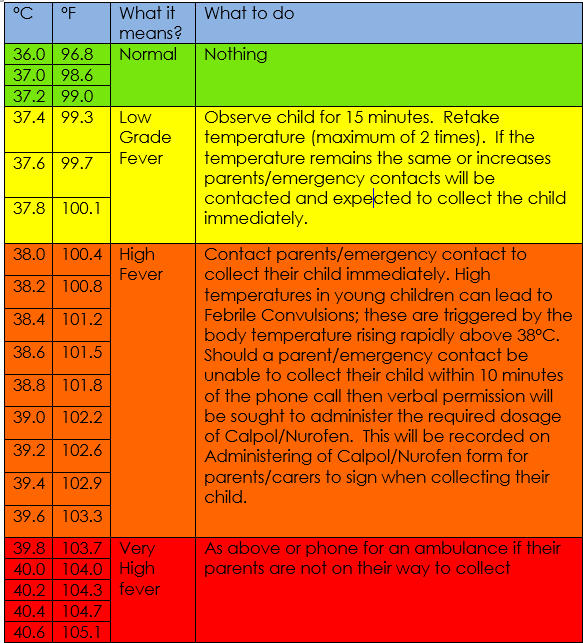
a. If your child’s temperature is taken and found to be in the low-grade fever category (see chart) in the indicated procedure will be actioned. Equally, if your child’s temperature is in the high fever category (see chart) the indicated procedure will be actioned.
High temperatures in young children can lead to Febrile Convulsions; these are triggered by the body temperature rising rapidly above 38°C.
Temperature chart
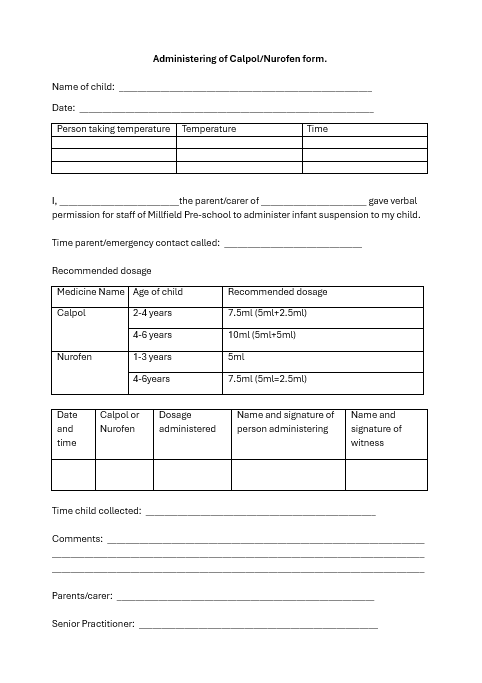
b. Should a parent/emergency contact be unable to collect their child within 10mins of the phone call then verbal permissions will be sought to administer the required dosage of Calpol/Nurofen. This will be recorded on Administering of Calpol/Nurofen form for parent/carer to sign when collecting their child.
- Administering Calpol/Nurofen
a. Calpol/Nurofen is administered as per the guideline set out by Calpol/Nurofen as per the age of the child.
CHILDREN WHO HAVE AN INHALER WILL NOT BE GIVEN NUROFEN – IT CAN EXACERBATE BREATHING DIFFICULTIES.
Dosage administering chart for Calpol
|
Child’s age |
How much |
|
2-4 years |
7.5ml (5ml+2.5ml) |
|
4-6 years |
10ml (5ml+5ml) |
Dosage administering chart for Nurofen
|
Child’s age |
How much |
|
1-3 years |
5ml |
|
4-6 years |
7.5ml |
Before administering Calpol/Nurofen the spoon/syringe will be sterilized.
- Storage of Calpol and Nurofen
a. Calpol and Nurofen are stored in a first aid cupboard, located in the main room, above the craft sink, out of reach from children.
IT IS VITAL THAT THIS POLICY AND PROCEDURE IS RESPECTED AND ADHERED TOO. THE MANAGEMENT DECISION IS FINAL. IT IS ESSENTIAL AS AN EARLY YEARS SETTING; WE PROTECT THE WELFARE OF ALL THE CHILDREN AND STAFF. IF A PARENT/CARER REFUSE TO COLLECT THEIR UNWELL CHILD, THIS WOULD BE CONSIDERED A SAFEGUARDING CONCERN AND A REFERRAL WOULD BE MADE TO CADS.
Antibiotics
a. If a child is prescribed antibiotics, they must be kept off preschool for 24 hours since first dose. This prevents the spread of infections and ensures they are well enough to attend the setting. This also eliminates the chances of a child having an allergic reaction to the medication.
b. We can only administer prescribed medication, not over the counter medication. This must include the prescription sticker, stating the child’s name, dose and date the medication has been prescribed.
Ongoing Conditions
a. If a child has an ongoing or long term condition, we will do our best to ensure the preschool is able to meet their needs. If their condition requires further training (eg. diabetes, peg feeding), at least 2 staff will complete this.
Signed: Clara Hall- Chairperson
Signed: Tegan Kidman- Lead Practitioner/Manager
Reviewed: 22nd April 2026.
Review: 22nd April 2027.